
AI robots are invading the fashion world and it’s getting weird, even for an industry that prides itself on pushing boundaries.
Robotics and fashion have been colliding since computer-controlled garment cutting transformed textile manufacturing in the 1960s. Machines developed by Gerber Scientific, and others that followed, automatically cut fabric patterns with high precision. It dramatically reduced waste and labor costs by turning clothing production into a programmable process that could be scaled.
The Evolution of Robotics in Fashion
In the 1990s, Japan’s Shima Seike eliminated the need to sew separate pieces together with its WholeGarment knitting machine. The system knit entire garments in one continuous process, which made it possible for clothes to be designed digitally and directly manufactured by machines.
Industrial robots started creeping their way onto the runway in the Y2K era. During the 1999 London Fashion Week, Alexander McQueen incorporated robotics into a seminal runway performance art pierce called “No. 13.” Model Shalom Harlow stepped onto a circular rotating platform wearing a pristine white strapless dress.

As the platform began spinning, two industrial robot arms repurposed form automotive manufacturing paint lines slowly came to life behind her. Their movement started out animal-like and snapped into mechanical precision. By the end, Harlow stood motionless in the dress that was rapidly turned into a chaotic, expressive work of art. The spectacle is considered one of the most iconic moments in the history of both robotics and fashion.
In the year 2000, the Turkish designer Hussein Chalayan created garments with embedded mechanical systems, including a remote-controllable dress now preserved at the Metropolitan Museum of Art. Engineers programmed the dress to activate in timed sequences. On the runway, a single dress could evolve through multiple fashion eras in seconds.

During Tokyo Fashion Week 2009, an ultra-realistic humanoid robot developed by Japan’s National Institute of Advanced Industrial Science and Technology (AIST) made its runway debut. Standing 158 cm (5 feet 2 inches), the android had 30 motors for body movements, and eight dedicated to facial expressions. The robot was a major departure for the institute’s HRP (Humanoid Robot Project) series, which mainly focused on heavy-duty use cases in factories and disaster zones. With its silicone skin, expressive face, and the ability to sing, the female-presenting robot was designed specifically for the entertainment and fashion sectors.

That same year, the Italian high-fashion powerhouse Prada had Lil Miquella, a computer-generated robot-like influencer, take over Milan Fashion Week. Created by the Los Angeles startup Brud, the digital human resembled a hyper-realistic young woman who appeared across digital billboards and online channels. People argued about whether she was real, what it meant for the future of modeling, and whether brands intended to replace humans with virtual replicas.
During New York Fashion Week in fall 2019, Alexander Wang placed Sophia the robot in the front row alongside celebrities like 21 Savage and Teyana Taylor. The ultra-realistic humanoid, developed by Hong Kong-based Hanson Robotics, observed the show like any other high-profile attendee would.

In 2023, robotic collaborations in fashion increased in frequency as artificial intelligence captured the cultural zeitgeist. Louis Vuitton deployed hyper-realistic animatronic versions of the Japanese artist Yayohi Kusama at its stores in cities like New York, London, and Paris.
For that year’s Paris Fashion Week, the French label Coperni teamed up with Boston Dynamics. The Massachusetts robotics firm’s Spot robodog interacted with models in choreographed sequences. In one particularly viral moment, a Spot robot pulled the coat off the Dutch model Rianne Van Rompaey to show off its fine-motor control and responsiveness.
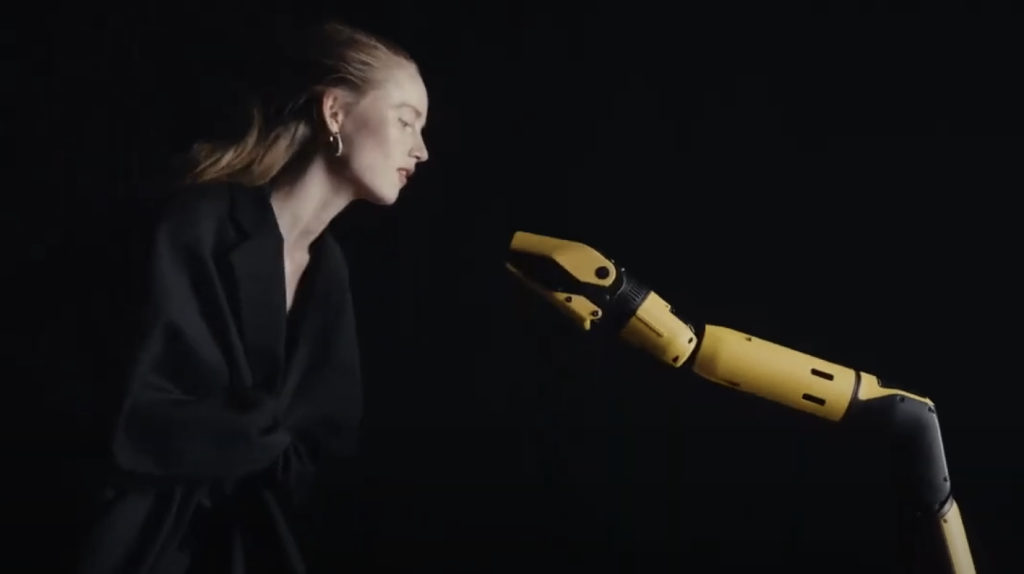
Two years later, Issey Miyake’s IM MEN line incorporated futuristic robotic elements for its runway debut at Paris Fashion Week 2025. Held at a former 16th-century monastery, the spectacle featured two monumental robotic arms designed by the Japanese artist Tokujin Yoshioka.
At that year’s Milan Fashion Week, the world-famous Ameca humanoid robot by Engineered Arts opened the show for Giuseppe Di Morabito, while Unitree’s G1 humanoid robot made its runway debut during the NMTG brand show during Shanghai Fashion Week. The compact humanoid joined a Unitree robotic dog on stage with a model who adorned it with a 3D-printed necklace shaped like a deer, a symbol of harmony and hope. And at China’s inaugural Humanoid Robot Games in Beijing, humanoid robots from startups like Booster Robotics, NOETIX Robotics, and DroidUp participated in one of the world’s first fashion shows for machines.

Legged robots, mostly Chinese, are becoming stables at fashion events all over the world, including the 2026 Zurich Fashion Week, where one of Unitree’s G1 humanoids acted as a live show opener and host.
At New York Fashion Week, designer Maia Hirsch showcased a robotic garment known as the Blooming Dress. The Cornell doctorate equipped the wearable system with embedded sensors and motors that physically transform in response to human interactions.

Meanwhile in Shenzhen, the rising robotics startup LimX Dynamics just unveiled Luna, a feminized version of its industrial humanoid robot built for the runway. LimX showcased the new robot at the Taobao Influencer Festival in Shanghai, where it catwalked alongside the popular Taiwanese actress Michelle Chen. Luna demonstrated its smooth and eerily humanlike catwalk. Its movements emphasized gracefulness and aesthetic presentation over raw technical abilities.
According to LimX, Luna is specifically tailored for public-facing events and media appearances. Standing 165 m (5 feet 5 inches), the robot weighs about 55 kg (121 lbs). It perceives its surroundings and navigates autonomously with its dual-depth cameras in its head and chest. Luna’s movements are more graceful than Oli’s, though the more masculine variant can dance fluidly and even do yoga-like stretches.

Launched in 2022 by SUSTECH professor Zhang Wei, LimX is scaling production of its humanoid robots and its TRON multi-form-factor platform after recently securing around $200 million in funding. Major backers include Alibaba Group and JD.com.
Luna is competing with humans masquerading as machines like the popular Chinese influencer Dalaotian (大佬甜Giovanna), who’s become a staple at high-profile fashion and tech events. She started out as a beauty influencer around 2018, but her robotic transformation began in 2024 following a divorce.

Now in her early 30s, Dalaotian stands 188 cm (6 feet 2 inches). She’s said in interviews that she’s spent hundreds of thousands of dollars on cosmetic surgery. Her appearance resembles a hyper-realistic near-future android with human softness and subtle mechanical accents. Her virtually unblinking expression and rigid body movements have tricked many into believing she’s an actual machine.
In San Francisco, the startup Mirror Mirror just emerged from stealth with an AI platform for brands to license the digital likenesses of real human models.

The company’s launch video is a nod to the 2006 classic The Devil Wears Prada. The startup was founded by Yusan Lin, a former model who earned a doctorate in artificial intelligence from Penn State in 2018. She previously worked as an applied scientist at Amazon Fashion and as a research scientist at Visa.
The platform’s pricing starts at $29 per month. The human models are paid per licensed use of their likenesses.
Meanwhile in Japan, a legendary roboticist is commercializing his long-running android research. In the future he envisions, robots are barely distinguishable from real people, and they interact with humans as peers. Read the full story here.