
Social media is flooded right now with posts waxing nostalgic about the year 2016, which happened to be a crazy year for robotics.
The general public was a few years into an obsession with lifelike robots. The HBO show Westworld became a cultural force with its artificial humans called “host drones” as a new class of increasingly smart and lifelike machines emerged. Many of the most advanced robots from the early were early prototypes that are now racing to market.
Sophia (Hanson Robotics)
It’s the year Hong Kong-based Hanson Robotics introduced the world to Sophia, a highly expressive social humanoid. The 2025 documentary My Robot Sophia peeled back the curtain on Hanson’s struggles commercializing the social robot. Hanson Robotics, launched by former Disney Imagineer David Hanson in the early 2000s, continues to advance Sophia with improved hardware and artificial intelligence.
Sophia’s appearance was inspired in part by Audrey Hepburn and its creator David Hanson’s wife. The humanoid is often seen with a transparent skull cap exposing its electronics, a conscious design choice to remind people it’s just a machine. Sophia chatted with Charlie Rose on 60 Minutes, got into a weird Twitter feud with Chrissy Teigen, and went on a pretend date with Will Smith. The robot’s witty and sometimes unpredictable responses sparked debate about the state of artificial intelligence.
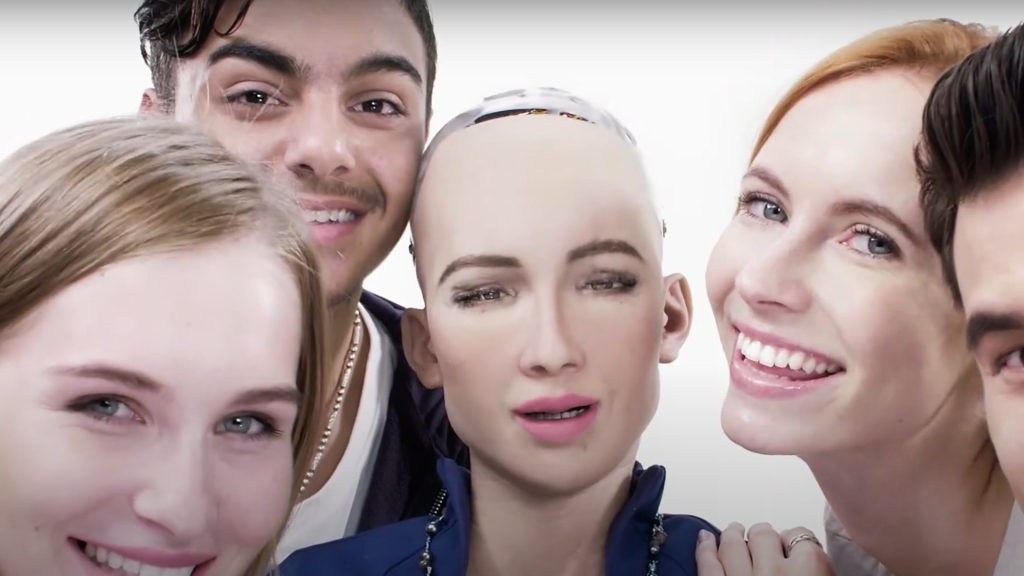
For many, Sophia embodied the promise, and fear, of an upcoming technological singularity, the hypothesized point where AI surpasses human intelligence. Others, like deep learning pioneer Yann LeCun, criticized the robot as a mere chatbot with a face.
“Well, if Sophia was just an art piece, I would have no problem with it but it’s presented as something else,” LeChun said in September 2019 on Lex Friedman’s podcast.
Sophia’s global media presence also amplified public awareness of the uncanny valley in a way few robots ever had, turning an academic theory into a mainstream talking point. The uncanny valley was coined to describe the strange feeling people report when something like almost human but not quite.
Harmony (Realbotix)
Another company focused on hyperrealism, Realbotix, also released its breakthrough Harmony platform in 2016. Then based in California, the robotics firm explicitly marketed the animatronic android head for private companionship. The robot mimicked human gestures during conversations. Small servo motors controlled its eyes, eyebrows, and mouth for realistic facial expressions. Realbotix’s Harmony app controlled the robot head. Priced at over $10K, the product was aimed at a niche market.

Ten years later, Realbotix was one of the standouts at CES 2026, where two of its humanoids chatted autonomously. The company sells its robots for prices ranging from $20,000 for a bust to more than $125,000 for a full-bodied variant.
Spot (Boston Dynamics)
The most impactful robot debut of 2016 was probably Spot by Boston Dynamics. The first publicly revealed prototypes culminated years of foundational research by the Massachusetts robotics leader. After years of testing, Spot became available to the public in 2019 for applications like inspections and monitoring.

Now owned by Hyundai, Boston Dynamics continues to scale production of the $75,000 quadruped while it pushes its other famous robot, Atlas, into the industrial workforce.
Jibo
The desktop companion Jibo was released to early customers in late 2016 after a wildly successful crowdfunding campaign. It was one of the most ambitious consumer robots of the era. MIT roboticist Cynthia Breazeal and her team developed Jibo to recognize faces, speak naturally, take photos, tell stories, and respond with expressive movements to convey personality and emotion.

The service shut down less than three years later due to a lack of funds. A revival of desktop companion robots is underway, with entries including Hugging Face’s Reachy Mini, the M1 by Zeroth Robotics, and Engineered Arts’ android busts like Ameca and Azi.
The Future of Robotics
Subscribe here for weekly, unbiased updates on rapid-fire development in robotics.